Stitch Fix Cuts Months-Long Design Work to One Week

The time it took to plan a style and get it into stores used to be measured in months. At a recent investor conference, Matt Baer, CEO of the online styling service Stitch Fix, said that after introducing AI into the development of its private-label products, that planning cycle has been reduced to one week.
The feature Baer also introduced, “Vision,” is a tool that lets customers use AI to preview how clothing would look on them before actually trying it on. AI not only puts together styles, but also identifies the customer segments most suited to those styles and presents them as images.
At the same event, Walmart Chief Growth Officer Seth Dallaire said the company is building its own AI tools, such as the shopping assistant “Sparky,” under human supervision. Revolve Group co-CEO Michael Karanikolas said one engineer developed technology to track customer movement in stores in about one and a half weeks, underscoring that all three companies have already brought AI into real operations.
Source · WWD, "How Fashion Retail Is Talking the AI Talk"
Consumers Trust AI, but Want Human Review Starting at $250

Forty-two percent of U.S. consumers said they trust AI tools in shopping decisions. The finding comes from a survey of more than 1,800 consumers in the U.S., U.K., Japan, and France by online retargeting company RTB House. Trust in AI still trails trust in friends and family (59%), but has come close at 44%.
However, trust did not mean handing over full authority. When an AI agent makes a purchase decision on their behalf for items over $250 (about 350,000 won), about 60% of respondents said they want a human to review it first. By contrast, 42% of millennials said they would allow AI to handle purchases under $250 if a refund within seven days is guaranteed, showing that the scope of what consumers are willing to delegate to AI differs by price and generation.
AI is already changing consumer behavior even before the purchase decision stage. Fifty-nine percent of respondents said they had discovered new brands thanks to AI, and 62% said they use AI for price comparisons. The most widely used AI tools for shopping were Google AI Overviews and ChatGPT (43% each), while users of Amazon’s voice shopping service Alexa have surpassed 350 million.
Source · Retail Dive, "Consumers warm up to agentic AI purchases"
Lookbook Snap. Select outfit candidates in one view using model, pose, and mood references
RealSnap’s Lookbook Snap is a feature that combines apparel photos with AI models, poses, and moods to create model outfit shots. It is useful for shopping mall detail-page managers or new-product merchandisers who need to prepare new outfit images every time new products launch. Rather than repeatedly booking models and studios and reshooting each pose, the workflow combines saved references.
For products that only have hanger shots or mannequin shots, this combination can replace the process with creating and comparing multiple outfit candidates at once.
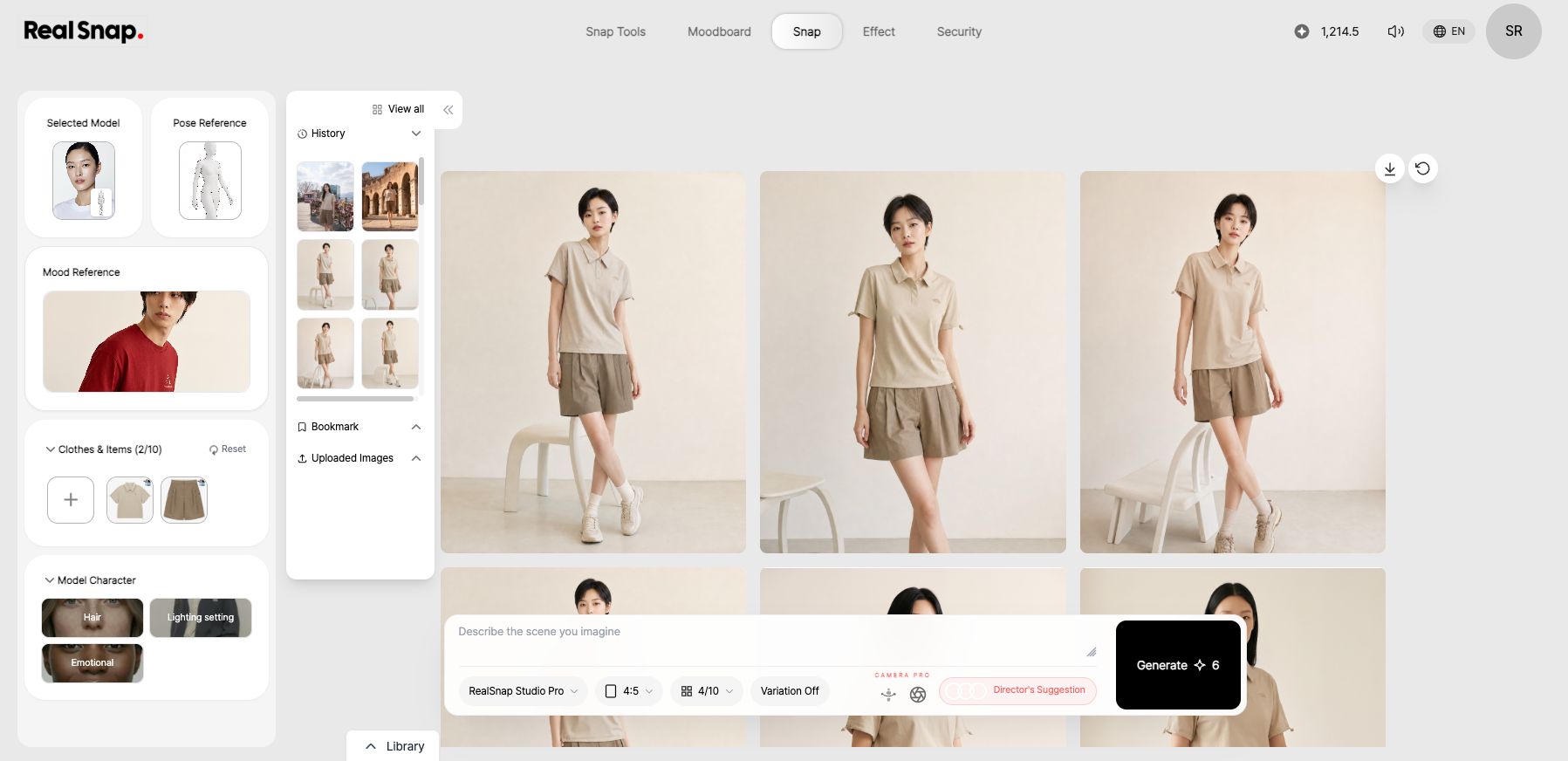
On the left side of the screen are the selected model, pose, mood reference, and registered clothing item, while on the right, result candidates generated from the same combination appear together. Instead of scheduling separate shoots for each pose or preparing and photographing the outfit again, you can keep the reference combination intact, increase the number of candidates, and compare them all at once.
RealSnap’s Lookbook Snap is especially suited to teams that need to create new outfit images frequently each season but have limited shoot resources. Instead of booking models again each time, teams can reuse saved model, pose, and mood references, making it worthwhile to try generating outfit-shot candidates starting with products that only remain as hanger shots.