Where Revenue Fell 10%, Two Creative Leaders Stepped In
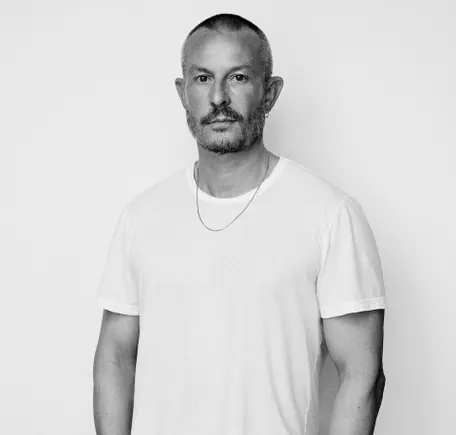
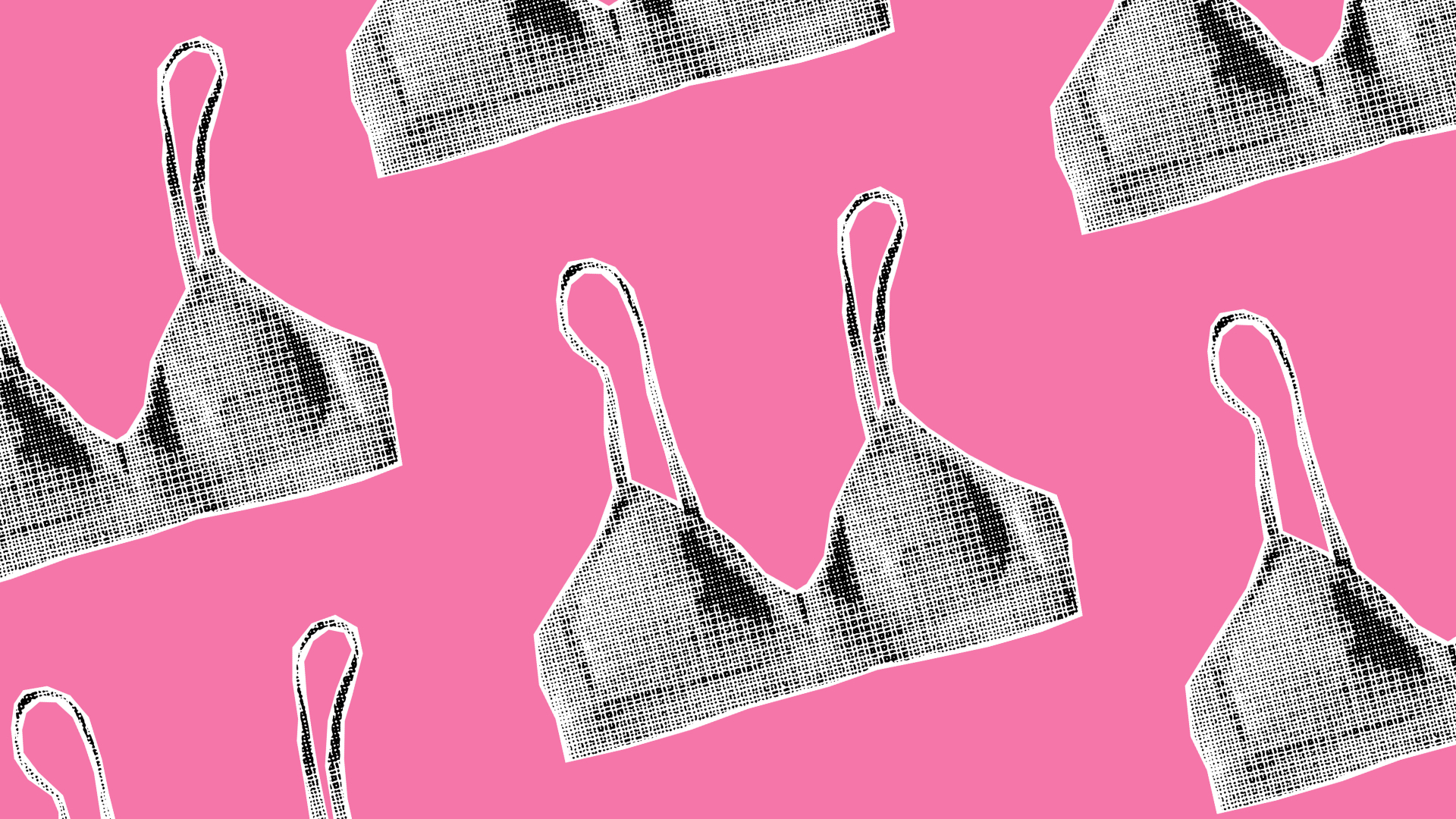
Kate Spade’s latest quarterly revenue fell 10% year over year to about US$220 million (about KRW 306 billion). The company’s next move was not cost cutting, but hiring. Parent company Tapestry announced that, effective August 26, Jonathan Saunders will become executive creative director, the top leader overseeing the brand’s products and overall visuals. Saunders most recently served as chief creative officer (CCO) at H&M-owned & Other Stories, and previously built his career at major houses including Diane von Furstenberg, Calvin Klein, Tiffany & Co., Pucci, and Alexander McQueen.
Saunders will report directly to Kate Spade brand president and CEO Eva Erdmann and will oversee product design and visual identity. In its press release, Tapestry described the appointment as “a new era for the brand,” while Erdmann said she aims to present an “elevated luxury vision” to a new generation of consumers together with Saunders. His role is expected to reset the brand’s overall tone, from product planning to store visuals.
The appointment is not a standalone move. Last week, Kate Spade also hired former L’Oreal executive Alison Bardiya as chief marketing officer (CMO). With revenue still declining, the brand has replaced both its creative and marketing leaders in succession, a move that reads as an effort to accelerate a shift in direction. The next point to watch is what first outputs the two leaders deliver in design and marketing, respectively.
Source · Retail Dive, "Kate Spade taps Jonathan Saunders as executive creative director"
Under Armour’s Bet: Adding US$30 Million to a US$500 Million Annual Marketing Budget
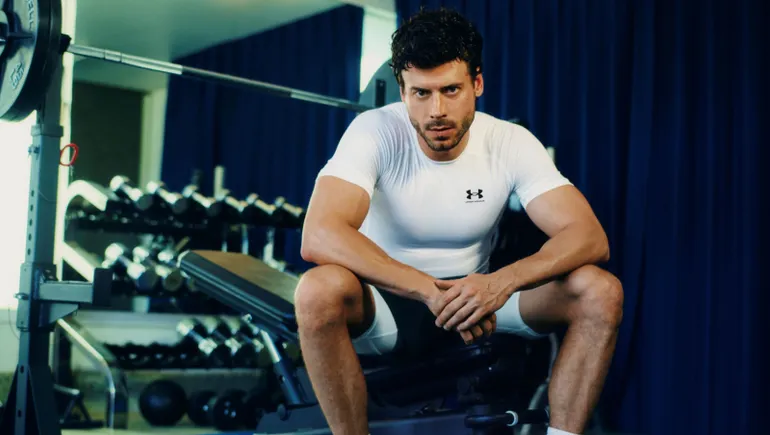
Under Armour spends about US$500 million (about KRW 690 billion) a year on marketing. In May, the company said it would add another US$30 million (about KRW 41.5 billion) this year, and its first bet was not a new product but actor François Arnaud. Arnaud, who stars in the Netflix hockey romance series “Heated Rivalry,” became the brand’s new global ambassador as of July 23.
The new campaign featuring Arnaud, “For When It’s Hot,” launched this week to coincide with what is typically the hottest week in North America. The ad shows neighbors watching Arnaud work out in a garage, spotlighting HeatGear products made with heat-ready materials, including UA Vanish Elite, UA Icon Fleece, UA Sola, and UA Reign XT. Chief communications officer Matt Donick explained that the story of Arnaud’s character, who reaches a breakthrough only after he stops conforming to others’ standards and accepts himself, aligns with the message the brand wants to convey.
The campaign extends the marketing strategy shift emphasized by CEO Kevin Plank. During the fourth-quarter earnings call, he acknowledged that while the brand’s identity lies in its products, it had not delivered storytelling strong enough to support those products, and said the company would focus marketing on existing products rather than pushing new items. Alongside the recently completed large-scale reduction in product lines (SKUs), the plan is to concentrate investment on the products, athletes, and stories that most clearly communicate performance credibility and brand differentiation.
A Dedicated Brand Face Completed With an AI Model Face
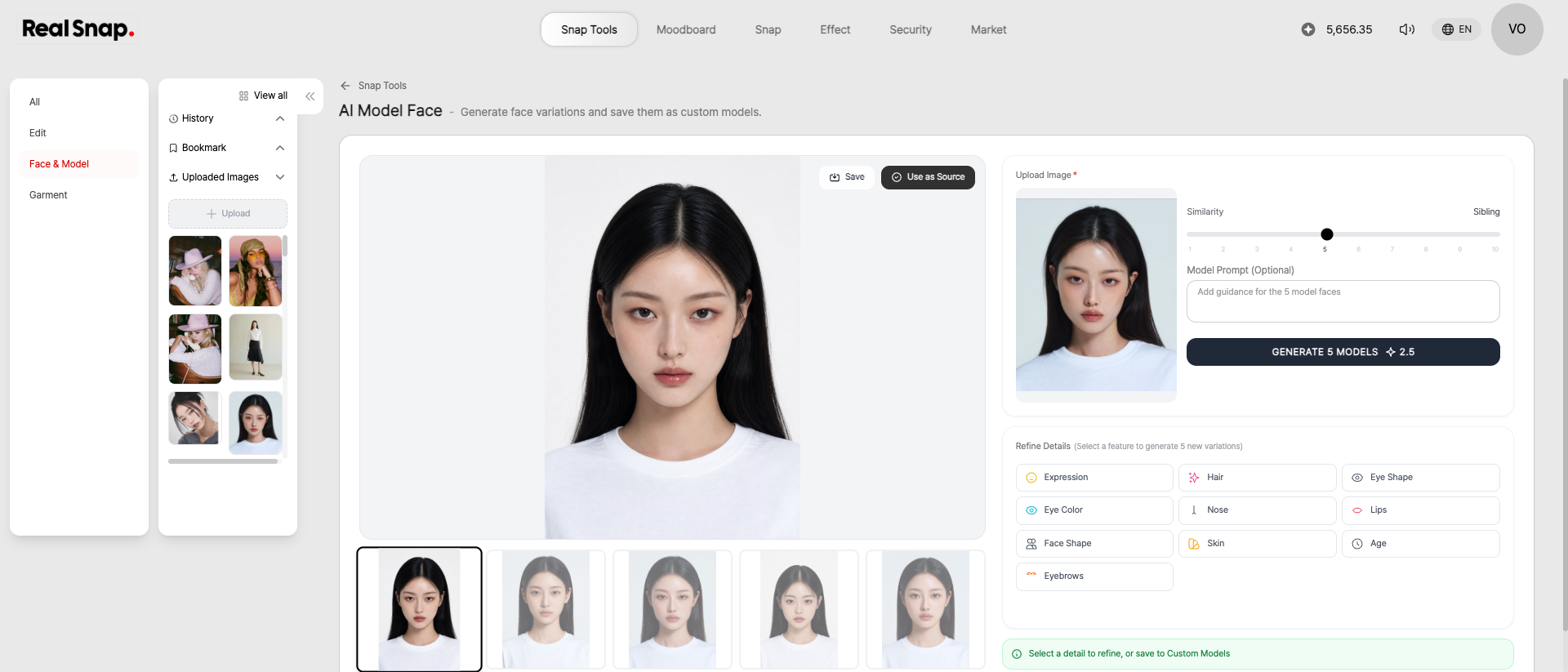
RealSnap’s AI Model Face is a tool that creates five variant model faces based on the impression of a single uploaded face photo. In Snap Tools, you can add a photo through Upload Image, adjust the Similarity slider to keep it close to the original (1) or push it toward a more different impression (10, Sibling), and add written guidance about the desired impression in the Model Prompt field. The resulting face can then be further refined by category, including Expression, Hair, Eye Shape, Eye Color, Nose, Lips, Face Shape, Skin, Age, and Eyebrows, and a result you like can be saved as a Custom Model so the same face can be reused in later shoots.
For brands that want to repeatedly feature the same face each season without portrait-rights contracts or casting a specific person, this screen can be used to choose one face and carry it through all subsequent snap work, such as lookbooks, studio shoots, and location shoots, instead of using a different model each time.
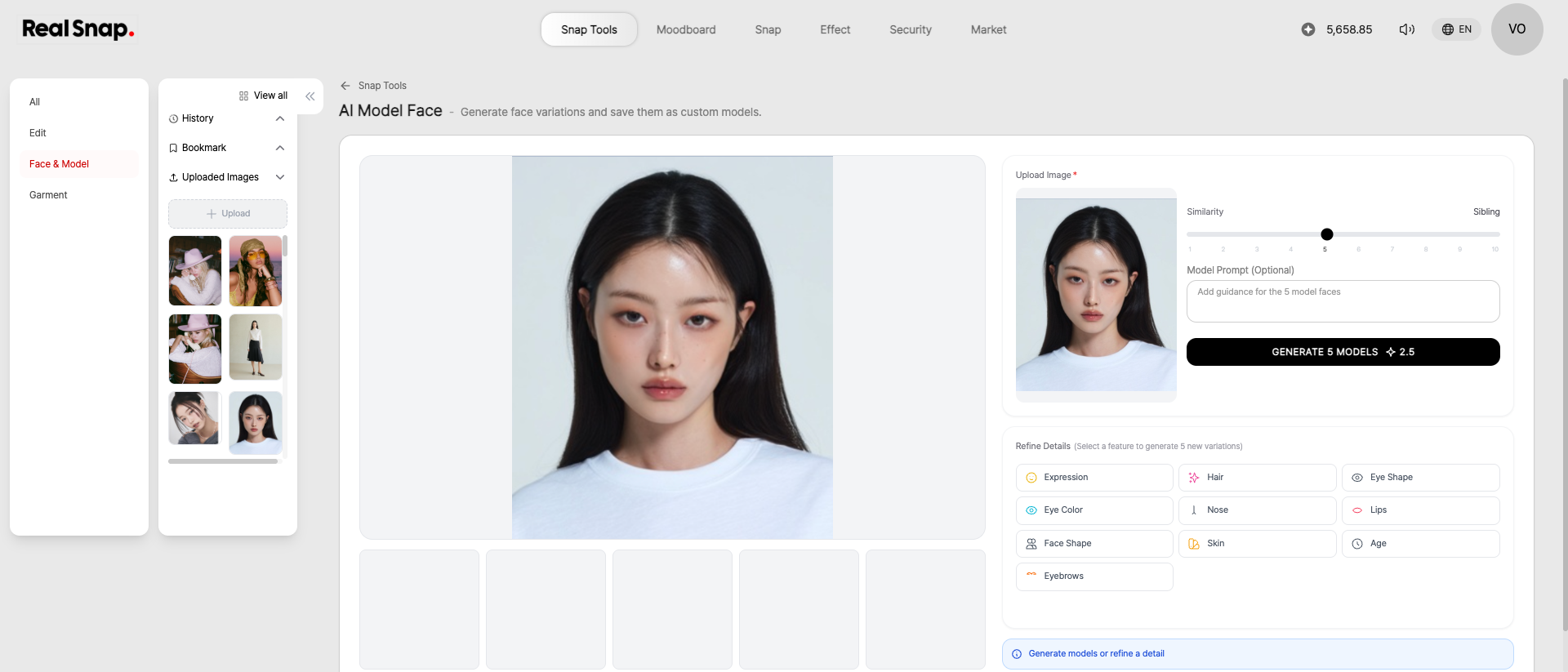
There are two values to decide at this stage. The Similarity slider determines how closely the 5 new faces should resemble the original: closer to 1 means more similar to the original, while closer to 10, labeled Sibling, means a more different impression. Model Prompt is a field where you can optionally describe a direction such as hairstyle or mood in text. Items listed at the lower right, such as Expression, Hair, and Eye Shape, are details that can be adjusted again after the results are generated; on this screen, they are still waiting unselected.