An era when 27% of clothes go unsold. The brand eliminating inventory
It is estimated that 27% of clothing produced worldwide ultimately goes unsold. In response to this problem, Norwegian outerwear brand Norwegian Rain has launched a made-to-order program alongside its AW26 (Fall/Winter 2026) collection, making garments only after orders are placed. The brand said this is the first made-to-order program focused exclusively on multifunctional, high-performance outerwear.
The program does not apply to the entire AW26 collection, but is limited to four archive styles reintroduced for this launch. They are the ankle-length 'Vienna Femme,' the unisex 'Gdansk,' the knee-length reversible 'T Walker Femme,' and the unisex 'Hokkaido,' each available in more than 20 fabric colors and materials. Only one coat is produced for each customer, leaving no inventory or overproduction.
The program will operate only at four flagship stores in Bergen, Oslo, Tokyo, and Paris, and follows the brand’s retail expansion through 'compact stores' from Kyoto to New York. Norwegian Rain described it as an extension of the slow fashion principles the brand has upheld.
Source · FashionUnited, "Norwegian Rain launches made-to-order programme for autumn/winter 2026 outerwear"
Product Snap: creating product shots after setting color standards first
RealSnap’s Product Snap is a feature for creating styled shots of the product itself without a model, allowing a single mood reference image to define both the background tone and color standards. This is a common situation for e-commerce managers or solo sellers who need to prepare product shots for detail pages by color option.
For products with many color and material options, the effort of repeatedly shooting the same composition while matching backgrounds and props increases. By setting color standards in a mood reference, it is possible to create product shots in the same tone without going through the same repeated setup again.
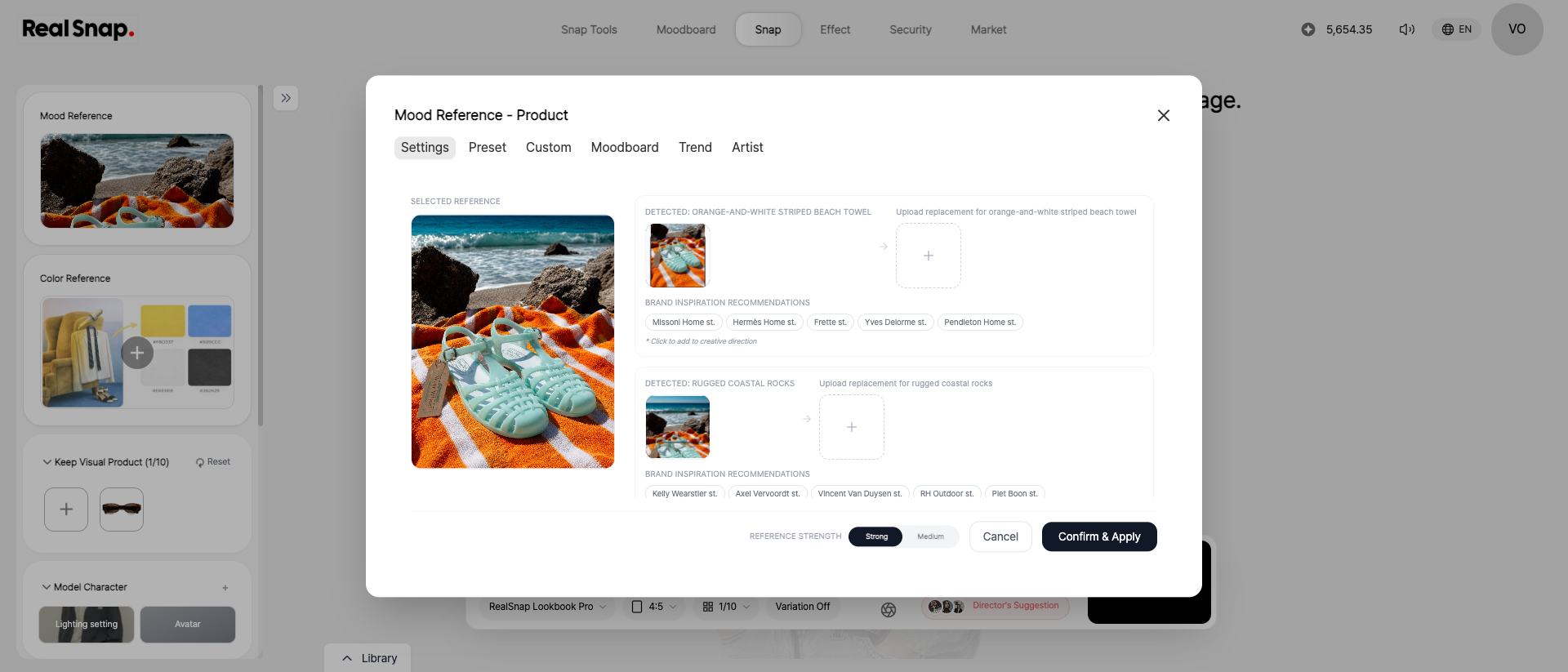
This screen recognizes the background props in a reference image item by item, allowing only specific elements to be replaced with other images or letting users choose how strongly to apply the reference. Without reshooting the entire background or sourcing new props, the color and mood standards can be adjusted on screen first.
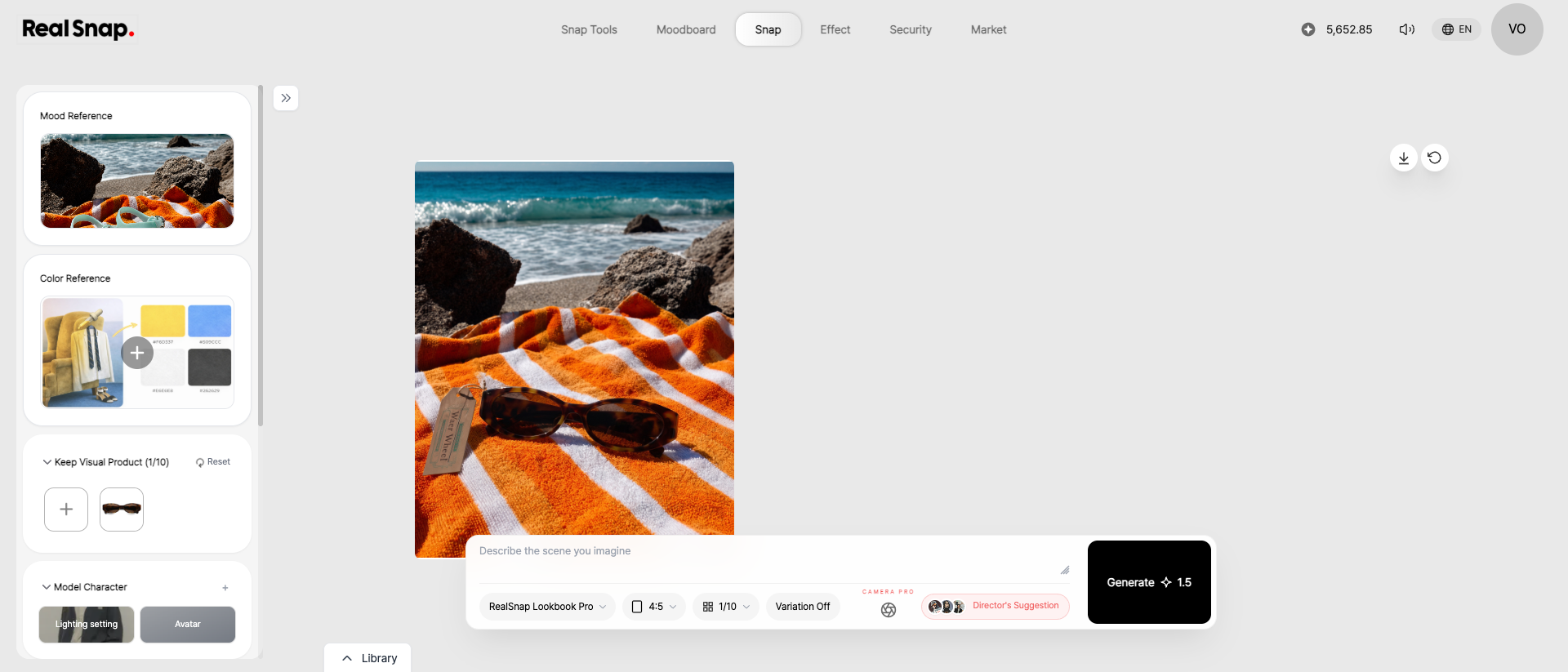
The generated result reflects the background and color palette specified as the Mood Reference, while the product itself retains its original shape and color. This makes it possible to expand product shots with the same composition into multiple versions without separately shooting backgrounds for each color.
RealSnap’s Product Snap is especially suited to brands that have many fabric color or material options but find it difficult to produce and photograph physical samples for every combination in advance. It is worth trying Product Snap for workflows that first establish the background tone and color standards with a mood reference, then prepare product shots for each color.